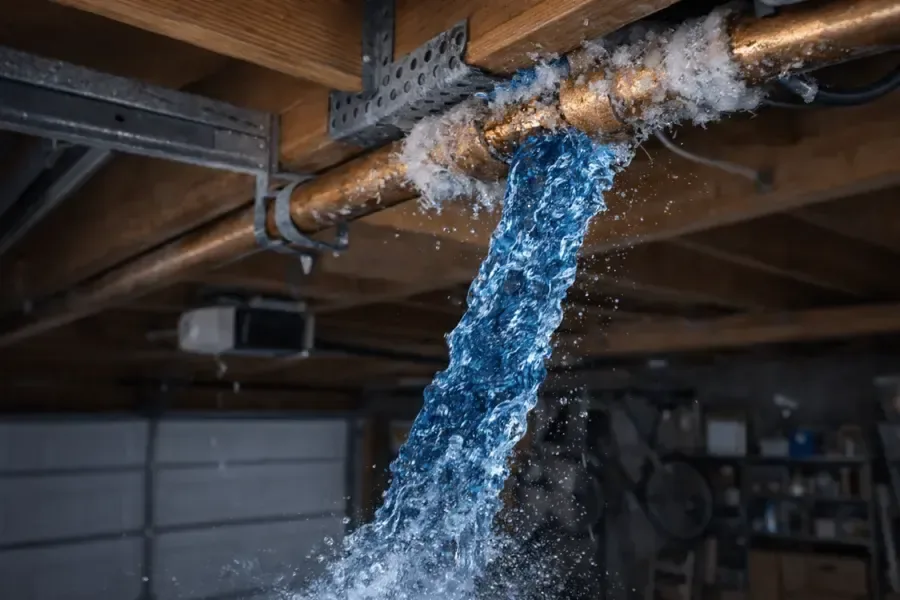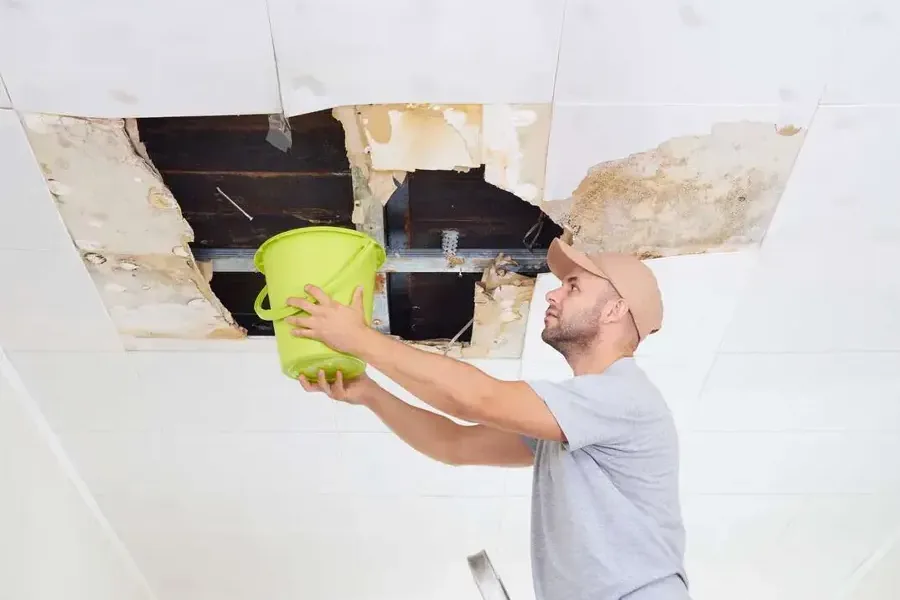
Cold winters with hard freezes put pipes at risk in homes across North Brunswick. The pipes that fail are often not the ones in the middle of the house: they run through garage ceilings, outside walls and crawl spaces.
Key takeaways
- Pipes freeze first where cold air reaches them: garage ceilings, outside walls and crawl spaces.
- A frozen pipe is not yet a flood. Water floods when the ice thaws or the pipe splits, so the shutoff valve matters before the thaw.
- Thawing is done with gentle heat, never an open flame, and with the faucet open so water can leave.
- A split pipe above a garage ceiling can soak the drywall, the insulation and the room above.
- Wet drywall and insulation are opened and dried, because mold can start within 24 to 48 hours.
Where pipes freeze in North Brunswick homes
Many homes here are 1960s to 1980s split-levels, colonials and ranches. Each style puts some plumbing against the cold.
A garage ceiling is a cold place for a supply pipe, especially where a room sits above the garage. Outside walls and crawl spaces share the same problem.
A pipe in an outside wall has little protection from the cold beyond a layer of insulation.
- Garage ceilings, especially under a bedroom or bathroom above the garage.
- Kitchen and bathroom pipes in outside walls.
- Crawl spaces and unheated utility areas.
- Exterior faucets and the pipes that feed them.
Signs a pipe is freezing or has frozen
No water at one faucet while the others work points to a localized freeze. That is the moment to find the main shutoff.
- A faucet that gives a trickle or nothing at all.
- Frost or a white coat on an exposed pipe.
- A pipe that feels far colder than its neighbors.
- A bulge or a hairline crack in the pipe.
How a pipe actually splits
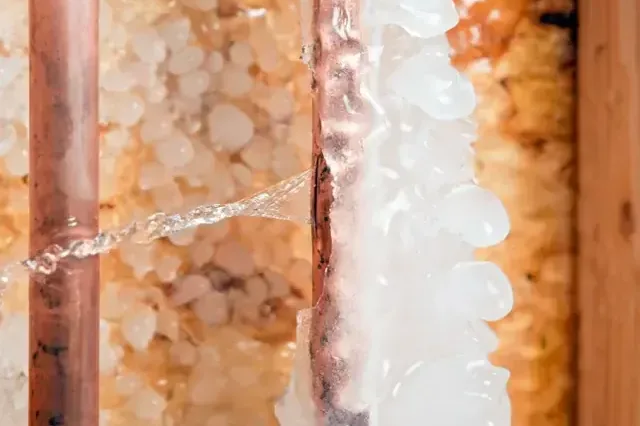
Water expands as it turns to ice, and pressure builds between the ice and a closed faucet. The pipe often splits not where the ice sits but in the stretch between the ice and the faucet.
That is why a split can sit hidden in a wall or ceiling for days, leaking only when the ice melts.
Thawing a pipe safely
A frozen pipe can be thawed in many cases, but how it is done decides whether it splits.
What helps
- Open the faucet so melting water can leave.
- Apply gentle heat with a hair dryer, heating pad or warm towels, starting nearest the faucet.
- Raise the room temperature and open the cabinet doors under sinks on outside walls.
- Keep checking for leaks along the pipe as it thaws.
What to avoid
- Never use an open flame, a propane torch or a kerosene heater.
- Do not leave any heat source unattended.
- Do not keep heating a bulged or cracked pipe. Shut off the water instead.
Crawl spaces and outside walls hide slow leaks
Crawl spaces and outside walls hide pipes where nobody looks. A slow leak from a crack in either place can soak insulation and framing before a stain shows.
- Insulation that is wet, compressed or discolored.
- A musty smell near an outside wall.
- A water meter that keeps moving when every fixture is off.
- A floor that feels damp near an outside wall.
When the pipe has already split
A split pipe often shows itself only when the ice melts and water pours out. Shut off the main water valve, turn off power to wet areas and open faucets to drain the system.
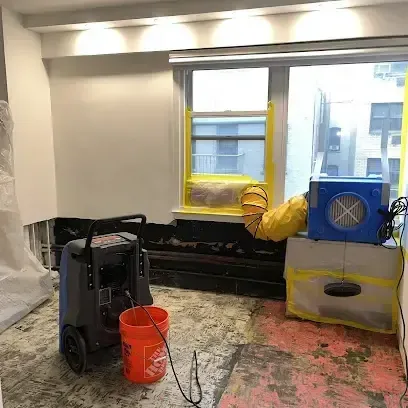
The extraction crew then removes the water, and the drying team opens and dries the wet areas. Burst pipe water damage is more than a plumbing repair, because water inside walls is invisible.
- Shut off the main water valve.
- Turn off power to wet areas at the breaker.
- Open faucets to drain the system.
- Move belongings out of the wet area.
- Photograph the damage before anything is moved.
A garage ceiling leak and the room above
A garage ceiling is usually drywall with insulation above it, and both hold water until the ceiling sags. The room above the garage can get wet along the floor framing too.
Wet drywall is cut open so trapped water can drain, insulation is removed and the framing is dried. Readings on the floor above show whether water traveled up and over, and ceiling leak water damage work follows that sequence.
A split pipe above a garage can drip for a long time before anything shows below.
- A brown stain that keeps spreading.
- A bulge or sag in the ceiling.
- A drip at a light fixture.
- Drywall that feels soft to a light press.
What the drying crew does after a split
After the water is out, the work shifts to the materials that cannot be seen.
- Moisture mapping of the ceiling, the walls and the floor above.
- Removal of insulation that soaked.
- Drywall opened so the cavity can dry.
- Air movers and dehumidifiers placed and checked daily.
- Final readings before any repair or paint.
Before the first hard freeze
Preparation takes an afternoon, and the list is short. A frozen pipe water damage loss is far harder than a checklist.
- Find the main shutoff and test that it turns.
- Disconnect and drain garden hoses and shut off exterior faucets.
- Insulate exposed pipes in garages, crawl spaces and outside walls.
- Keep the heat on and open cabinet doors on outside walls on cold nights.
- Let a faucet drip on the coldest nights.
- Keep garage doors closed on cold nights.
- Seal gaps where pipes enter the house.
- Keep the thermostat steady rather than lowering it overnight.
Questions
Does a frozen pipe always burst?
No. Many pipes thaw without splitting. The ones that split usually crack where ice built up pressure, and the leak often appears only after the thaw.
Should the main water valve be shut off for a frozen pipe?
If the pipe is cracked or leaking, yes. For a pipe that is only frozen, it is wise to know where the valve is before heating starts.
Is a leak in a garage ceiling an emergency?
Yes, because drywall and insulation hold water and can fail suddenly. Keep people out from under any bulge.
How long does drying take after a split pipe?
Drying commonly takes several days. The crew keeps equipment running until readings show the framing and drywall are dry.
Can the damage be handled without opening walls?
Sometimes. Readings show whether water entered a wall cavity, and sections that took on a lot of water are opened so they can dry.
Is it safe to leave a faucet dripping?
A slow drip keeps water moving, which makes freezing less likely. It wastes some water, so it is saved for the coldest nights.
Who should check pipes before winter?
A plumber can inspect exposed pipes and add insulation. The restoration team handles the water damage if one splits.
What if a faucet has no water but nothing is leaking?
The pipe may be frozen but not split. Open the faucet, thaw it gently and check along the pipe as water returns. If water appears where it should not, shut off the main valve.
Should a frozen pipe be left alone until spring?
No. A frozen pipe can split when it thaws on its own, and a leak found late soaks more material. Thawing it gently while watching for water is safer.