A cloudburst can drop more rain than the ground can absorb, and a basement is where the surplus tends to end up. In North Brunswick, many homes from the 1960s to the 1980s are split-levels, colonials and ranches with basements, so a hard summer storm or a nor'easter often means water on the slab.
Key takeaways
- Keep the power off and stay out of standing water until the electricity to that level is shut off from a dry spot.
- Standing water comes out first, then soaked carpet, pad and boxes, because porous materials hold water long after the surface looks dry.
- Clay soils drain slowly, so foundation walls can stay wet for days after the rain stops, and moisture readings show when drying is truly done.
- Mold can begin within 24 to 48 hours of damp conditions, so a wet basement is dried that same week.
- Photos of the water level and the damaged belongings, taken before anything moves, make any later claim easier to document.
What a cloudburst does to a basement in North Brunswick
Summer cloudbursts, nor'easters and the remnants of tropical storms such as Floyd in 1999 and Ida in 2021 all shape the local flood picture. Any of them can deliver rain faster than a yard, a window well or a sump pit can handle.
The red shale and clay soils of the Newark Basin drain slowly. Rain tends to sit against foundation walls instead of soaking away, and that pressure looks for the easiest way in.
Water usually enters a basement in one of a few ways.
- Seepage where the floor slab meets the foundation wall.
- Window wells and door openings that fill faster than they drain.
- A sump pit that overflows, or a pump that quits.
- A floor drain that pushes water up when outdoor drains are full, which is treated as sewage rather than rain.
The first moves before anyone goes downstairs
The first few decisions protect people and keep the loss from growing.
Make the space safe
Electricity is the first hazard. If water reaches outlets, a panel, a furnace or a water heater, the power to that level stays off until it is safe to restore.
Nobody should wade in with the power on, and nobody should touch the panel while standing in water.
Protect what can still be saved
Once the power question is settled, a few quick moves make a big difference.
- Lift electronics, papers, photos and boxes to dry shelves or the floor above.
- Pull rugs off wet carpet and set furniture legs on plastic or wood blocks.
- Photograph the water level, the walls and every damaged item before anything moves.
- Leave drywall and flooring alone so the restoration team can open them correctly.
What the extraction crew does first
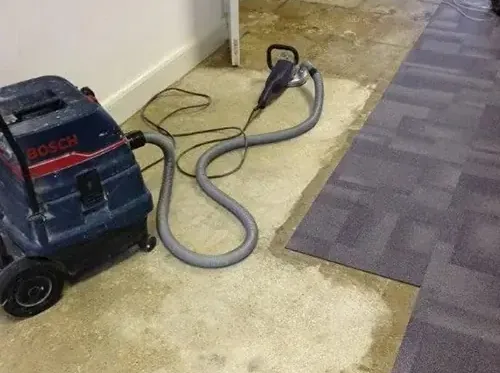
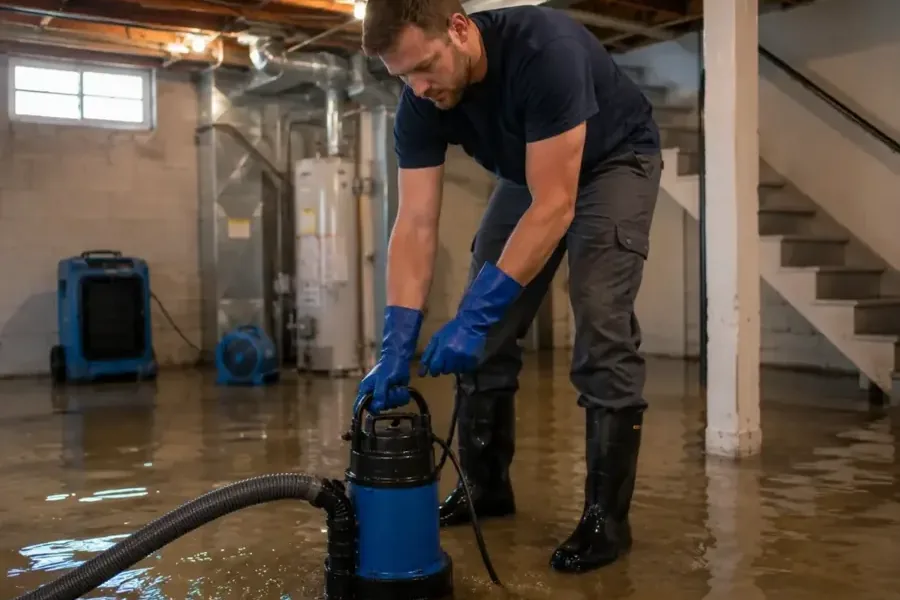
The first job is simple: get the water out. The extraction crew pumps standing water with submersible pumps and pulls what is left from carpet and pad with truck-mounted or portable units.
Water extraction comes before anything else, because the longer water stands, the further moisture travels into block, wood and drywall.
Rain that ran across a yard and into a basement carries soil and bacteria, so wet porous materials are usually removed instead of saved.
Speed matters because wet drywall and wood begin to weaken as soon as they absorb water. Early extraction usually means less removal later.
- Standing water pumped out of the lowest spots first.
- Carpet and pad lifted and extracted, or removed if soaked.
- Wet boxes, particle board and soaked insulation hauled out.
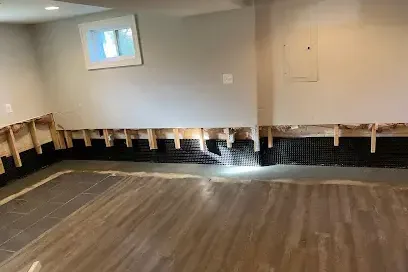
- Drywall opened at the bottom so the wall cavity can dry.
- Moisture readings taken on block, slab, framing and drywall.
Hidden water: where the crew checks next
Water in a basement does not stay where it first lands. It wicks up the bottom of drywall, runs under paneling and settles behind finished walls and under stair framing.
The crew checks the base of the furnace and water heater, the cavity behind finished walls, and the corners where cool, damp air lingers longest.
- Moisture meter readings on drywall and framing at several heights.
- Thermal imaging to spot cool, wet areas behind finished surfaces.
- Checks under stairs, in closets and along exterior walls.
- Notes on every area where readings stay high after extraction.
Drying a basement that sits on slow soil
Extraction removes the water that can be seen. Drying removes the water that cannot.
Why readings matter more than looks
A basement floor can feel dry while the slab and the block walls still hold moisture. Slow-draining clay outside keeps feeding that moisture inward, so a meter tells the truth that a hand cannot.
Readings are taken on the first day and repeated daily, and the equipment stays until the numbers match a dry reference.
Equipment and what to expect
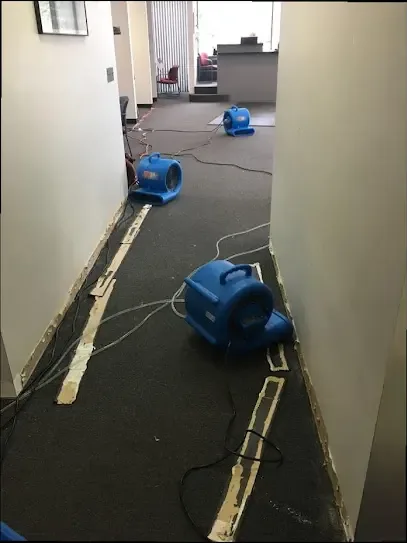
The drying team sets air movers to push air across wet surfaces and dehumidifiers, often LGR units, to pull moisture out of the air. Structural drying commonly takes several days, and longer for thick block walls and finished rooms.
A closed basement with dehumidifiers running will be warm and loud. That is the process working.
When the sump pump is part of the problem
Many local basements rely on a sump pit, and a pump can fail with no warning. A power outage during a storm can stop a pump just when it is needed most.
A failed pump does not always mean the walls are leaking, so the repair plan starts with the pump. The sump pump failure cleanup handles the water the pit let in.
- A motor that runs without moving water.
- A pit that stays full after the rain has stopped.
- A float that sticks or a pump that cycles constantly.
- No discharge at the outdoor end of the pipe.
What to keep and what to replace
After a cloudburst, the question is usually which items can be dried and which cannot. The restoration team sorts materials by how they absorb water.
- Usually dried in place: concrete, block, solid wood framing and hard furniture with sealed finishes.
- Often removed: carpet pad, soaked drywall, insulation and particle board.
- Case by case: carpet, hardwood, upholstered furniture and electronics, depending on how long they sat wet.
Repair planning
A basement flooding cleanup plan lists these decisions room by room, so the owner knows what is being dried and what is being replaced.
Questions
Can a flooded basement be dried without removing the drywall?
Sometimes. Drywall that wicked only a little water can dry in place, while wet drywall at the bottom of a wall is opened so the cavity can dry. Readings on each section decide.
How long does a basement take to dry after a cloudburst?
Drying commonly takes several days, and thick block walls or finished rooms take longer. The crew keeps equipment running until moisture readings come back to normal.
Is rainwater in a basement safe to touch?
Not safely. Rain that crosses a yard and enters a basement picks up soil and bacteria, so gloves and boots are the minimum and the power must be off first.
What if the water came up through a floor drain?
Water from a floor drain is handled as sewage, a higher hazard category than rain. The porous materials it touched are removed, and surfaces are cleaned and disinfected.
Should the sump pump be replaced before the cleanup starts?
The water comes out first, because a new pump cannot keep up with a full basement. The pump can be tested or replaced once the standing water is gone.
Is a dehumidifier needed once the water is gone?
Yes. Surfaces can look dry while the air and the materials still carry moisture, and dehumidifiers pull that moisture out until the readings match dry areas.